 |
Search: |
| Home | Lifestyle | |
|
Monday, February 24, 2003
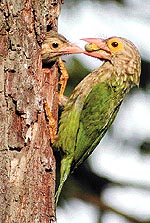
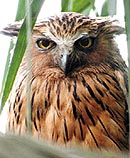
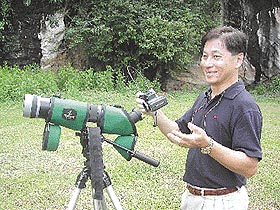
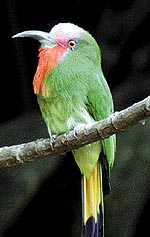
A bird in the eye WATCH the birdie, as the phrase goes, but bird lovers would now be able to see even the delicate markings of their feathered friends now that “digiscoping” is becoming popular among the birding fraternity. Digiscoping, which refers to a revolutionary technique of attaching a digital camera to the eyepiece of a spotting scope, is fast gaining local and international attention for its ability to get clearer and better pictures of subjects far away.
The resulting photographs are so sharp that even a bird’s feathers, markings and even eye colour can be made out. Company director Laurence Poh, 50, who is recognised by his fellow birders as the “Father of Digiscoping”, says he chanced across the technique in February 1999 when he happened to be looking out of the window of his house at Taman Golf, Ipoh. “I saw this big bird perching on a dead tree at the nearby golf course, and I didn’t know what it was. “So I grabbed a spotting scope and my digital camera, an Olympus C-900 Zoom which I’d just bought to try and get pictures of it,” he relates. Wanting to get a better look of the bird (which later turned out to be a Crested Honey Buzzard), Poh decided to combine the two.
Poh found that although the resulting image was not that clear, what did emerge was enough to intrigue and prompt him to investigate further. A fellow birder Cheang Kum Seng, a retired bank employee, eventually came up with the idea of mounting the camera to the scope’s eyepiece using a simple screw-on adaptor. The adaptor is now being marketed locally and internationally for digiscopers everywhere. News of the technique was passed around in newsgroups and through e-mail, and soon articles on Poh’s discovery began appearing in various local and foreign publications. Among them were the June 2001 issue of Digital Camera, the Nov/Dec 2001 issue of Bird Watchers Digest, the March 2001 issue of the Malaysian Nature Society (MNS) magazine and various newspapers. More and more bird photographers began turning to digiscoping, and the technique also drew attention from enthusiasts overseas like the United States’ raptor expert and author William Clark and former New York Central Park ranger Dr Robert DeCandido who is now a freelance guide taking people on bird tours. Poh corresponds with many such birders, and currently holds slide shows of his work and maintains a website showcasing his portfolio of photographs. Two years ago, he was invited to give a presentation before British High Commissioner Graham Fry, a keen ornithologist, at the latter’s residence during an MNS fund-raising dinner. Funnily enough, Poh finds it hard to explain why so many people seem to like his work so much. “When people look at my photographs, they seem to find something special about them. “When I was in Genting last year, I happened to meet another bird watcher who later told me I seem to ‘capture the soul of the bird’, which is a most difficult thing to do. Perhaps that’s it,” says Poh.
Poh’s love affair with photography began around the age of 12 when his family would ask him to take pictures of numerous weddings, funerals and other social functions. “I would use my father’s Kodak Instamatic and take photographs of everything under the sun – nature, plants, abstracts, sunsets and sunrises. “Photography has been in my blood since young, but I had left off for many years after I returned from my studies in London.” After spending seven years in Britain, Poh went to Kuala Lumpur in 1977 as an advertising photographer for two years. His hobby then had to take a back seat when he started a limestone powder business in Ipoh, and it was only recently that he took up his camera again to take photographs of birds. He and his wife Audrey had earlier begun to take an interest in nature, which soon graduated into a passion for bird watching, or “birding”, around 1987 after joining the Malaysian Nature Society. “What I love is the sheer beauty of the birds, from the freedom they enjoy and their ability to fly, to their variety in the tranquillity of nature. “Bird watching is a challenging sport, and I became hooked on the challenges of spotting elusive species,” he relates. Every “birder” has an eye for that special bird to look out for, and for many months, Poh had been on the hunt for the Wallace’s Hawk Eagle, a rainforest bird that, he says, is quite uncommon in Malaysia. Because of development, he says, the raptor is slowly being pushed off its natural habitat and their numbers could be dwindling. “It took some time and numerous trips to Langkawi where someone spotted one, but we finally managed to shoot the raptor at a timber concession in Belum.” However, Poh prefers not to publicise exact locations as he fears the news would attract poachers.
Every once in a while, his group would hear gunshots in the distance and Laurence recalls feeling upset upon seeing people passing them with their catches in hand. “Some of the birds are migratory, and imagine having to travel all this way from Siberia or Japan or China, for instance, only for them to be shot here,” he remarks. Poh points out that bird watching is gaining popularity in Malaysia, even though the number of people who engage in it here is still small. Other than satisfying the urge to see beautiful birds in their natural habitat, birders also end up contributing to the field of ornithology, he says. “Through our observations, we are able to report on the call, voice, eating habits and other behaviour of birds we’ve photographed. “We have made a lot of discoveries over the years, such as the behavioural habits of birds like the Black-Winged Stilt found in wetlands like paddy fields, Little Egret and Oriental Pratincole.” Normally migrants, these are now nesting here and some have even made Malaysia their home, Poh and his fellow birders have learnt. Their observations are often circulated in newsgroups or reported to the Malaysian Nature Society’s Bird Conservation Council. Lately, Poh says, advances in the field of bird photography through digiscoping has helped another group of people – bird guide authors. Because many of these authors often rely on the carcasses of birds, referred to as skins, (in museums) to list down the bird’s markings (the various stripes and features of a bird), Poh explains that the authors could sometimes miss out on important details – soft tissue such as the eyes which have long deteriorated. “With the photographs taken with digiscoping, however, the authors can make out these details, allowing them to revise and update their guides,” he says. Poh’s website is at www.laurencepoh.com |

|